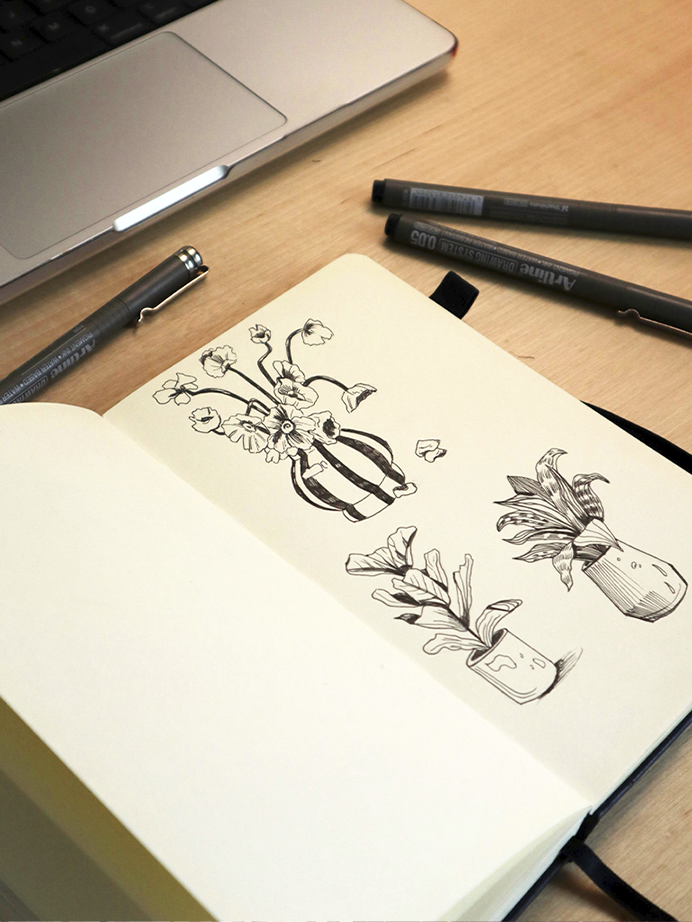
I want to tell you about something I do when my mind won’t stop.
I have health anxiety. If you know, you know — the spiral that starts with a small worry and quickly becomes something much bigger, louder, and harder to reason your way out of. The reassurance-seeking. The Googling you swore you wouldn’t do. The constant low hum of what if.
Over the years I’ve tried plenty of things to quiet it. And while I’ll never claim any of them is a cure, two simple art practices have become something I return to again and again — depending on my mood, my energy, and how loud the noise in my head happens to be that day. Neither requires any artistic skill. Neither produces anything you need to judge or finish or share. They’re just quiet, intentional ways to come back to yourself.
And it turns out, the science has quite a lot to say about why they work.
Why Anxiety Loves an Idle Mind
Anxiety, at its core, is your brain deciding the present moment isn’t safe and dragging your attention somewhere else — usually somewhere catastrophic and imaginary. Anxiety often involves rumination — repetitive looping thoughts that circle through the same worries without ever quite resolving them.
What actually helps is giving the mind something else to do. Not to suppress the feelings, but to gently redirect attention — anchoring it firmly in the present moment before the spiral gets too deep. This is the foundation of grounding, and it’s exactly what making art does quietly, naturally, and without any of the effort that formal meditation can sometimes demand of an anxious brain.
Grounding techniques engage your senses, your body, or your thoughts in ways that interrupt spirals of anxiety or rumination — and creative, hands-on activities are among the most effective ways to do exactly that.
The First Practice: Tracing
Here’s the thing about anxiety and drawing: the moment you introduce the pressure of doing it right, you’ve handed your anxiety a brand new thread to pull. The blank page becomes another thing to worry about. The imperfect line becomes evidence of something. Tracing removes that entirely.
When you trace an image you love — a butterfly, a flower, a botanical — the creative decision is already made. The shape is already there. Your only job is to follow its edges, slowly and carefully and attentively. And that attentiveness is exactly what gently pulls you out of your own head.
The repetitive nature of tracing induces a mild trance-like state, allowing us to enter a flow state where time seems to slow down and awareness becomes sharply focused on the present moment. Flow — the state of being fully absorbed in an activity — is essentially the opposite of anxiety. When you’re in it, the inner critic goes quiet. You focus on the movement of your hand, the texture of the paper, the brightness of any colours you add. You don’t engage with the anxious feelings, and so they drift away.
Tracing is one of the most accessible routes into that state, precisely because it asks just enough of you — enough to require focus, not so much as to trigger overwhelm. And neurologically, as we become absorbed in tracing, the brain releases dopamine and serotonin — neurotransmitters associated with pleasure and relaxation — creating a genuine sense of calm and wellbeing.
How to try it:
Make yourself a cosy space first — this part matters more than it sounds. A cup of tea, soft music, a candle if you like one. The ritual of settling in signals to your nervous system that this time is safe and slow and yours.
Then find an image that feels beautiful and calming. (Bonus point if you go on a walk and take a photo of something beautiful to trace!) A butterfly works wonderfully — familiar, gentle shapes with soft curves that feel grounding rather than complex. I often use my own reference photos, or find something simple on Pinterest. Open it in Procreate, or print it and place tracing paper over the top, and follow the lines with your stylus or pencil. Go slowly. Notice each curve. Let your eyes and hand move together without rushing toward a result.
Once traced, colour it in. The repetitive movement of colouring is soothing and calming for people experiencing high stress and heightened anxiety — and a 2016 study by Kaimal et al. found that 75% of participants’ cortisol levels dropped after 45 minutes of art making, regardless of their previous experience or skill level. Beginners and practised artists felt the benefit equally.
This is also, genuinely, just fun. Choosing colours, building a palette, watching something take on life and warmth — there’s a particular pleasure in it that has nothing to do with being good at art and everything to do with being present in a moment that feels kind. I created a video about this practice, which you can watch below.
The Second Practice: The Looping Line
If the tracing practice is something to hold onto — a structure for when anxiety is loud — the looping line is something to wander into. It’s better suited to days when the noise is a little quieter and you want to gently coax creativity out alongside the calm.
Start with a blank page and a pen or pencil — digital or paper, whichever you prefer. Draw a single continuous line, swirling and looping across the page without lifting your pencil. Let it curve back on itself, overlap, meander. Don’t plan it. Don’t aim for anything in particular. When it feels ready, join it back to where you started, closing the whole thing into one unbroken shape.
Now look at what you have. You’ll find dozens of tiny enclosed spaces — little loops and pockets created where the line crosses over itself. This is where the practice begins to open up.
Start filling them in. Colour some. Add a small motif inside another — a tiny leaf, a dot, a simple flower, words that bring comfort. Let one section suggest something and follow that instinct. See what begins to emerge. There are no rules and no wrong choices here. The line already exists; your only job is to respond to it.
The calming, repetitive motion of this kind of drawing helps reduce arousal in the amygdala — the brain’s threat-detection centre — with studies on mindfulness-based art showing a decrease in amygdala activity when participants engage in emotionally soothing creative tasks. In simpler terms: the more your hands are quietly, repetitively occupied, the less your brain is scanning for danger.
There’s also something quietly powerful about the lack of a blank page. By starting with that single wandering line, you’ve already broken the most intimidating moment — the empty white space — before you’ve had time to feel anxious about it. What’s left is just exploration. Curiosity. Play.
I have a full video walkthrough of this practice if you’d like to see it in action — watch it below.
Why Neither of These Requires You to Be “An Artist”
This is important, and I’ll say it plainly: these practices are not about making good art. They are not about developing a skill or producing something worth keeping. They are about giving your nervous system a place to land.
Active art creation offers advantages including self-expression and a sense of accomplishment, and fosters mindfulness — helping individuals stay present and disconnect from daily worries. And crucially, the research shows that colouring is an easy way to lower anxiety and reduce burnout, especially when approached with a sense of mindfulness and present-moment awareness. Semantic Scholarronniekovacs
The science doesn’t ask whether you can draw a perfect butterfly. It just asks whether you showed up and moved the pen.
A Small, Honest Note
These practices are not a replacement for professional support if your anxiety is significantly affecting your daily life. They are one tool — a gentle, accessible one — not a solution, and I’d always encourage you to speak to your GP or a mental health professional if you’re struggling.
What they are, for me, is a way to interrupt the spiral before it takes hold. A way to come back to my body. A way to remember that I am here, right now, in this room — with a cup of tea, a stylus or a pencil, and something quietly beautiful to make.
And sometimes, that’s exactly enough.
If you’re curious about the wider science of why simple art-making is so effective for focus and stress, my previous post — Why Doodling Makes You Calmer, Sharper and More Present — explores the research in more depth. The two sit beautifully alongside each other.
And if you’re looking for a gentle creative starting point beyond these practices, my free 4-week pattern prompt guide is always there — no experience needed, just a willingness to begin. 🌿
References
- Kaimal, G., Ray, K., & Muniz, J. (2016). Reduction of cortisol levels and participants’ responses following art making. Art Therapy, 33(2), 74–80. https://doi.org/10.1080/07421656.2016.1166832
- Koo, M., Chen, H-P., & Yeh, Y-C. (2020). Coloring activities for anxiety reduction and mood improvement: A randomized controlled study. Evidence-Based Complementary and Alternative Medicine. https://doi.org/10.1155/2020/6964737
- Flett, J.A.M., et al. (2017). Sharpen your pencils: Preliminary evidence that adult coloring reduces depressive symptoms and anxiety. Creativity Research Journal. https://doi.org/10.1080/10400419.2017.1376505
- Healthline. (2021). Drawing for anxiety: Benefits, easy exercises and more. https://www.healthline.com/health/mental-health/anxiety-drawing
- Csikszentmihalyi, M. (1990). Flow: The psychology of optimal experience. Harper & Row.
- Curry, N.A., & Kasser, T. (2005). Can colouring mandalas reduce anxiety? Art Therapy: Journal of the American Art Therapy Association, 22(2), 81–85.